
Three Years, 0.05 BTC: A Long-Horizon Reading of Pool State
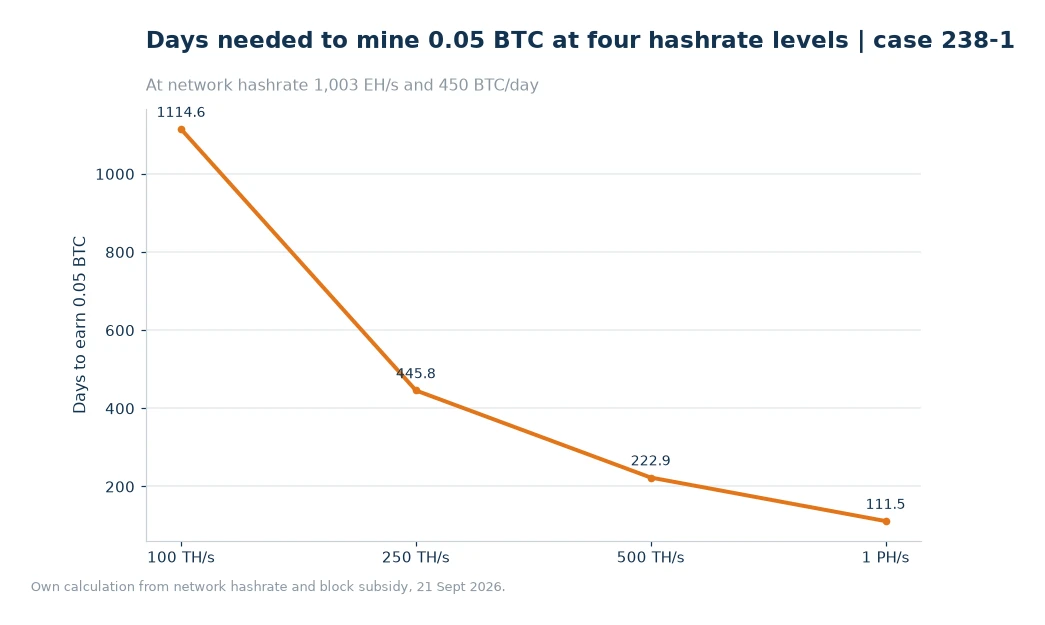
Fifty thousandths of a bitcoin is not a target you check daily; it is one you check quarterly. At 100 TH/s it takes 1,114.6 days, just over three years, while 1 PH/s compresses the same goal to 111.5 days. The long version is where difficulty drift stops being a footnote and becomes the main character.

Key takeaways
- 0.05 BTC takes 1,114.6 days at 100 TH/s, 445.8 days at 250 TH/s and 111.5 days at 1 PH/s.
- Three years is long enough for several difficulty cycles, so a fixed finish date cannot be promised.
- Pool Hashrate is a figure to re-read each quarter, not a constant to plug in once.
- Pool Luck averages out over a thousand days, but it can dominate any single month, which is why the review window matters.
A long target turns difficulty into the main character
Over a fortnight, difficulty barely matters. The subsidy is fixed, your hashrate is roughly fixed, and the daily credit lands where the formula says it should. Stretch the same target over three years and the picture inverts. Difficulty becomes the largest single influence on the finish date, and the hashrate you bought is only the starting condition.
That is not a reason to avoid a long target. It is a reason to describe it honestly. A 0.05 BTC goal at 100 TH/s is a statement about the next 1,114.6 days at today's conditions, and anyone who treats it as a delivery date has confused a snapshot with a schedule. The arithmetic still works; it just needs to be renewed.
Three years, counted in quarters
1,114.6 days is 36.6 months, or a little over twelve quarters. At 100 TH/s the quarterly output is about 0.00404 BTC, so the target is reached in the twelfth quarter with a small remainder. Framing it that way does two useful things: it gives you a checkpoint every ninety days, and it makes a 5% shortfall visible long before the end.
A quarterly checkpoint is also the natural rhythm of the inputs. Difficulty adjusts far more often than that, but the adjustments accumulate into a trend you can see at three months and cannot see at three days. Hardware health follows the same pattern: a fan that is 3% slower each month is invisible on Monday and obvious by March.
Pool Hashrate, re-read every quarter
The ViaBTC Pool Hashrate view holds the two totals: this pool's combined hashrate and the network's. For a long target, the second one does most of the work. It is the divisor in every forecast, and it has been rising for most of the chain's history, which means yesterday's estimate is usually optimistic.
Write the number down each quarter rather than trusting memory. A miner who began at 900 EH/s and is now reading 1,003 EH/s has seen an 11% increase in the divisor, which pushes a 1,114.6-day estimate out by roughly 123 days if nothing else changes. That is not a crisis, but it is a fact worth having on the same page as the target.
Pool Luck across a thousand days
Pool Luck is a short-window measure and a long-window comfort. In any given month a pool can find materially more or fewer blocks than its share predicts, and a PPLNS miner sees that in the balance. Over a thousand days the clumps pile up on both sides and the average settles close to the expectation.
For a three-year plan, the practical use of luck is to size the buffer rather than to predict the next month. If your deadline cannot absorb a 5% shortfall, the deadline is doing more work than the mining is. Move the date, add hashrate, or accept a smaller target; those are the only three levers, and luck is not one of them.
The grid from 100 TH/s to 1 PH/s
The table gives the target in days, years and a quarterly figure, so the same plan can be read at three different zoom levels.
| Hashrate | Days to 0.05 BTC | Years at 365 days | BTC per 90 days |
|---|---|---|---|
| 100 TH/s | 1114.6 | 3.05 | 0.004037 |
| 250 TH/s | 445.8 | 1.22 | 0.010094 |
| 500 TH/s | 222.9 | 0.61 | 0.020187 |
| 1 PH/s | 111.5 | 0.31 | 0.040375 |
Read the last column against your own review habit. At 100 TH/s, ninety days produces about 0.00404 BTC, which is 8% of the target. That is a meaningful enough slice to see whether the plan is tracking, and small enough that a single bad week does not dominate the reading.
The years column is less useful than it looks, and that is worth admitting. Nobody experiences an average year; they experience four seasons, a tariff change, a heatwave and a firmware release. The number is there to compare sizes, not to describe any particular twelve months you will actually live through.
What the horizon does to the hardware
A three-year plan will probably outlive the machine you start with. Fans fail, thermal paste dries, power supplies drift and firmware support ends. None of that is unusual, and none of it invalidates the target; it simply means the plan needs a replacement line, not just a revenue line. Budgeting for one spare unit per several running is a common way to keep a long schedule honest.
There is also a resale question. A unit bought for a three-year run has a residual value at the end, and a unit bought for a one-year sprint does not have time to lose much of it. Long horizons make the purchase price a smaller share of the total cost and the electricity a larger one, which is another way of saying that efficiency matters more the longer you plan to run.
Keep the maintenance log in the same folder as the target. A fan replaced in month eight, a power supply swapped in month twenty, a board that lost a hash rate sensor: those entries explain a shortfall faster than any dashboard, and they are the record a buyer will ask for if the unit is ever sold.
Worked example
Build the three-year case from the network totals and check the fastest alternative.
- Divide the daily issuance by the network: 450 ÷ 1,003,100,000 = 0.00000044861 BTC per TH/s.
- For 100 TH/s: 100 × 0.00000044861 = 0.000044861 BTC a day.
- Days to 0.05 BTC: 0.05 ÷ 0.000044861 = 1114.6.
- Years: 1114.6 ÷ 365 = 3.05.
- Quarterly output: 0.000044861 × 90 = 0.004037 BTC.
- At 1 PH/s: 0.00044861 BTC a day, so 0.05 ÷ 0.00044861 = 111.5 days, or 0.31 years.
Frequently asked questions
How long does 0.05 BTC take at 100 TH/s?
1,114.6 days, about 3.05 years, at a daily credit of 0.000044861 BTC with the network at 1,003 EH/s.
Is a three-year mining plan reliable?
It is arithmetic, not a promise. The estimate holds only while hashrate, difficulty and uptime stay near today's values; the next difficulty estimate was −2.12% on 21 Sept 2026, and larger moves in either direction are normal over three years.
Why review quarterly rather than monthly?
At 100 TH/s a month covers about 0.001346 BTC, where one unlucky stretch can look like a trend. A quarter covers 0.004037 BTC and lets Pool Luck average out before you change the plan.
Put the next review date in the calendar
Pick a date ninety days out, write down the network total, your delivered hashrate and the balance on that day, and compare the third figure with the quarterly column. If the three agree, the plan is behaving. If the balance is behind, the cause is usually visible in one of the first two lines, and the fix is a maintenance task rather than a new strategy.
The Profit Calculator will rebuild the daily figure at current difficulty, and the multi-currency wallet holds the accumulating balance in the same account as the mining record. A quarterly review is easier when both numbers live in one place.
Sources: ViaBTC pool state, calculator and wallet pages; chain inputs read 21 Sept 2026: network hashrate 1,003 EH/s, difficulty 132.76 T, subsidy 3.125 BTC per block, 144 blocks a day, BTC $84,692, next difficulty estimate −2.12%. Years use 365 days and quarters use 90. Figures read 21 Sept 2026, published 24 Oct 2026[1].